Updated: May 2026
Dani Tribe Customs and Rituals: An Ethnographic Overview (2026)
What we know, what we observe, what we don’t.
An overview of Dani social structure, religion, and the customs visitors encounter during expeditions. Written with input from Dani co-guides. (See Dani people for context.)
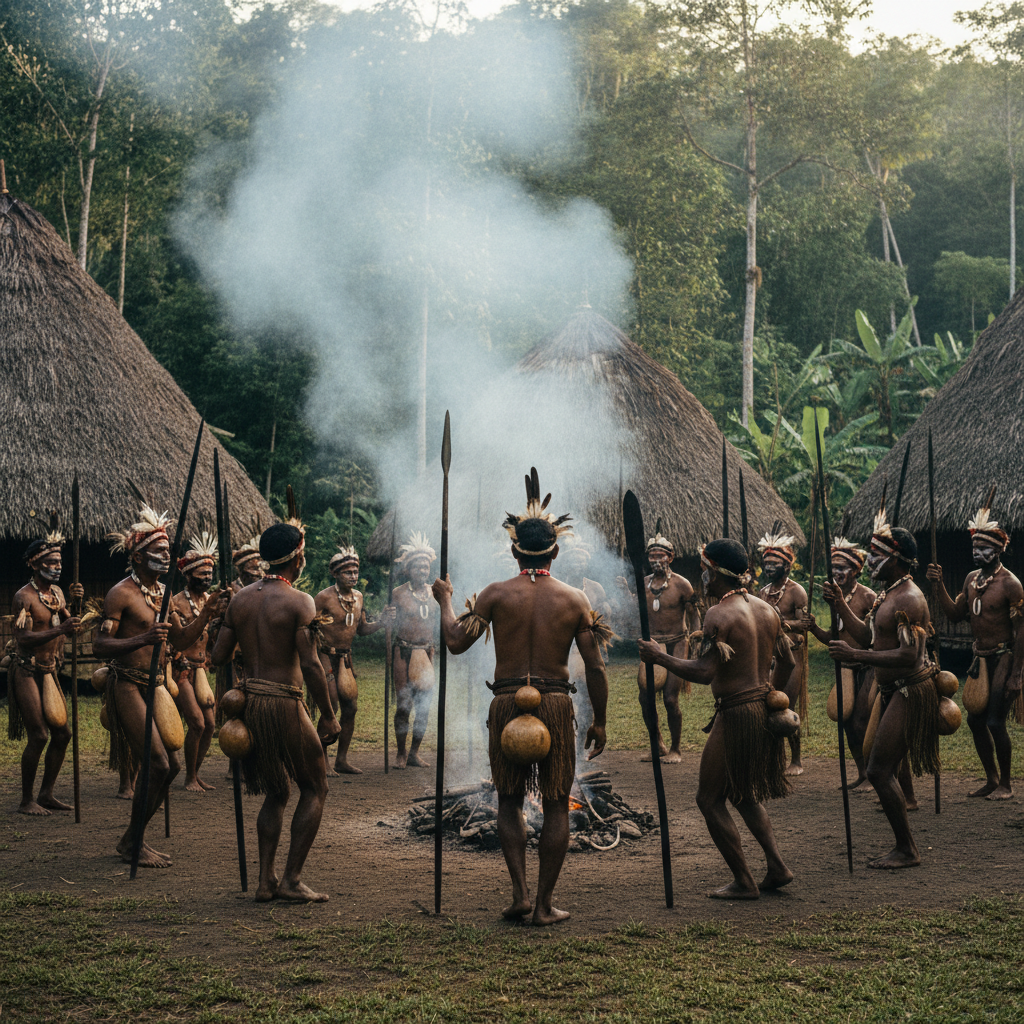 Dani tribe ceremony with traditional dance and smoke”/>
The Dani (sometimes spelled Ndani) are the largest indigenous group in the Baliem Valley region of central Papua. Population estimates range from 100,000 to 250,000 across the central highlands. They speak Dani language (or one of three regional dialects), and most communities also use Bahasa Indonesia for inter-tribal and government interactions.
For visitors, the most-asked questions concern social structure, religion, and the famously photographed customs around clothing, rituals, and the well-known finger-cutting practice. This article covers what we know from anthropological research and what our Dani co-guides allow us to share with visitors.
Social structure
Dani society is organized at three nested levels: the household (typically extended-family), the hamlet (5-15 households), and the alliance (multiple hamlets bound by warfare and marriage history). Leadership is non-hereditary — “big men” earn influence through generosity, oratory, and demonstrated capacity to maintain alliances. Women hold significant social authority, particularly around agriculture, pig husbandry, and inter-household exchange networks.
Traditional Dani settlements consist of round thatch-roofed houses called honai (men’s house) and ebei (women’s house), arranged around a central courtyard. Many villages now have additional Indonesian-style structures alongside the honai — schools, clinics, churches.
Religion and worldview
Traditional Dani religion centers on ancestral spirits, with elaborate cosmologies around death, the afterlife, and the ongoing influence of ancestors on the living world. The famous “smoked mummy” of Akima — a 250+ year-old preserved ancestor displayed in a curated cultural-tourism context — is one visible expression of this.
Since the 1950s, much of the Dani population has converted to Christianity (predominantly Protestant denominations introduced by missionary efforts). Most Dani we visit identify as both Christian and traditionally observant — the cosmologies coexist rather than replace each other. Sundays are universally a rest day with church service.
Clothing and the koteka
The koteka — a gourd worn by men in traditional dress — is the most photographed element of Dani culture. In contemporary practice, koteka use varies widely: ceremonial events almost universally include traditional attire, daily life uses Western-style clothing in most villages, and a small number of elders wear koteka daily as personal practice.
Visitors should not assume traditional dress will be on display every day. We brief our groups: photography of traditional dress is permitted with explicit invitation only, never as ambush photography. Our Dani co-guides communicate the protocols.
The finger-cutting custom
One of the most-discussed Dani customs is the historical practice of finger amputation by women in mourning for close relatives. This was widely documented in 20th-century anthropological work. The practice has been formally discouraged since the 1980s and is no longer performed on younger women. Visitors will see older women whose fingers were amputated decades ago — this is not a contemporary practice and we ask visitors to treat the topic respectfully if it comes up in conversation.
This is not a ritual visitors witness. It was a private mourning practice, not a tourist event.
The pig feast (Bakar Batu)
The pig-cooking ceremony — using heated stones to cook pork, vegetables, and sweet potatoes wrapped in leaves — is the Dani version of a celebratory communal meal. It is performed for marriages, funeral wakes, dispute resolutions, and welcoming events. Several villages in our circuit will perform a Bakar Batu for our groups when we coordinate in advance — this involves contributing toward the cost of the pig and provides extended time with multiple village families.
If you’re interested in attending a Bakar Batu, mention this when booking. We can typically arrange one mid-expedition for an additional $400-$600 community fee.
What we ask of visitors
Photography only with explicit consent (we’ll mediate the request). No giving cash or candy directly to children — channel any contributions through the village treasurer or expedition organizer. No imposing photographs of religious objects or sacred items. Respect the rest day on Sunday. Listen more than you talk; observation is the point.
Plan an expedition
We design 5-day, 8-day, and 12-day Baliem Valley expeditions. Tell us your style and we’ll match you to the right one.
Deep within the emerald embrace of Papua’s Baliem Valley, where mist often clings to ancient peaks, the Dani people uphold traditions that resonate with the very pulse of the land. Their customs are not merely relics of the past but living practices, meticulously observed and deeply interwoven with their social fabric, spiritual beliefs, and agricultural rhythms. For the discerning traveler, understanding these rituals offers an unparalleled window into a culture that has, for centuries, thrived in one of the world’s most striking and remote landscapes.
The enduring significance of the pig feast (Bakar Batu)
More than just a culinary event, the Bakar Batu, or “stone burning” pig feast, stands as the cornerstone of Dani communal life. This elaborate ceremony is a profound social, spiritual, and economic gathering, marking significant life events such as marriages, dispute resolutions, and welcoming honored guests. The preparations alone can span several days, involving the collective effort of entire villages to gather firewood, prepare the cooking pit, and, crucially, secure the pigs, which are considered the highest form of wealth and sacrifice among the Dani. This ritual is a vibrant demonstration of reciprocity and community bonding, reinforcing social hierarchies and cementing alliances.
The actual feast day unfolds with a remarkable display of indigenous engineering and communal spirit. Stones are heated in a large pit until glowing red, then carefully layered with fresh leaves, succulent pork, and an abundance of sweet potatoes – the staple crop of the Baliem Valley. This method of cooking, passed down through countless generations, ensures a slow, even roast that infuses the food with earthy flavors. The air fills with the aroma of roasting meat and the joyous sounds of celebration, as families and clans come together to share the bounty. A single major Bakar Batu can involve dozens of pigs, sometimes exceeding 50 for significant inter-clan events, symbolizing immense prosperity and goodwill.
For visitors, witnessing a Bakar Batu is an extraordinary privilege, offering a rare and authentic glimpse into the heart of Dani culture. It is an experience that transcends mere observation, inviting a deeper appreciation for the intricate customs that bind this community. These feasts are not daily occurrences; they are meticulously planned for special occasions, often tailored to coincide with significant cultural exchanges or the arrival of respected visitors, making each one a distinctive and memorable immersion into an ancient tradition.
Ancestral reverence and the mummified legacy
Among the most unique and spiritually profound Dani customs is the practice of ancestral mummification, a testament to their deep respect for lineage and the enduring presence of their forebears. Unlike the elaborate mummification techniques of ancient Egypt, the Dani method involves a simpler, yet equally effective, process of smoking the deceased over a slow fire for weeks or months. This preserves the body, transforming it into a revered effigy that continues to reside within the village, serving as a tangible link to the past and a guardian spirit for the community.
These mummies, often adorned with traditional regalia and seated in a position of honor, are not objects of macabre fascination but rather cherished members of the family, consulted and revered in times of need. They are believed to possess spiritual power and wisdom, continuing to guide and protect their descendants. In specific villages within the Baliem Valley, such as Akima and Jiwika, a select few of these remarkably preserved mummies can still be seen today, carefully maintained by their descendants who uphold the sacred trust of their ancestors. Some of these mummies are believed to be over 250 years old, offering a profound historical connection.
Engaging with this aspect of Dani culture requires the utmost respect and sensitivity. For the luxury traveler, it represents an unparalleled opportunity for cultural immersion, moving beyond superficial observation to understand the profound spiritual underpinnings of a society that honors its past in such a unique way. The careful stewardship of these mummies by current generations highlights a living tradition that bridges centuries, connecting the present-day Dani to a rich and unbroken ancestral line. For further reading on the broader cultural context of Papua, Wikipedia offers a comprehensive overview of the Dani people.
Honai architecture and the rhythms of daily life
The traditional Dani dwelling, known as the Honai, is a remarkable example of indigenous architecture perfectly adapted to the cool, often damp, highland climate of the Baliem Valley. These circular huts, constructed primarily from wood, bamboo, and a meticulously thatched roof of grass, are more than just shelters; they are central to the social structure and daily rhythms of Dani life. Typically, a Dani compound consists of several Honai: separate huts for men (often multi-story), women, and a communal cooking hut, each serving distinct purposes and reinforcing traditional gender roles and community cohesion.
The design of the Honai is ingeniously practical. The circular shape minimizes wind resistance, while the thick thatched roof provides excellent insulation against the cold mountain nights. Inside, a raised sleeping platform keeps inhabitants away from the damp ground, and a central fire pit offers warmth and light. The smoke from the fire, while often thick, also acts as an insect repellent and helps to cure the building materials, enhancing their longevity. A typical Honai is approximately 4-5 meters in diameter and, despite its modest size, can house 5-10 people, fostering close communal living.
Life within and around the Honai revolves around the agricultural calendar, with sweet potatoes being the primary crop, cultivated in meticulously maintained gardens. Men are often involved in hunting, land clearing, and constructing the Honai, while women are responsible for tending the gardens, raising children, and preparing food. These daily activities, intertwined with the unique architecture, paint a vivid picture of a self-sufficient and harmonious society deeply connected to its environment. Exploring these living villages offers a tangible connection to the enduring practices that define the Dani, providing insights into a way of life that has sustained itself for millennia. For more information on Indonesia’s diverse cultural heritage, indonesia.travel provides further context on Papua.