Updated: June 2026
Wamena Airport Flights from Jayapura: Schedules and Carriers 2026
Two carriers. One mountain runway. Plan accordingly.
Wamena (WMX) is one of Indonesia’s most weather-dependent airports. Here’s how flights from Jayapura actually work in 2026. (See Dani people for context.)
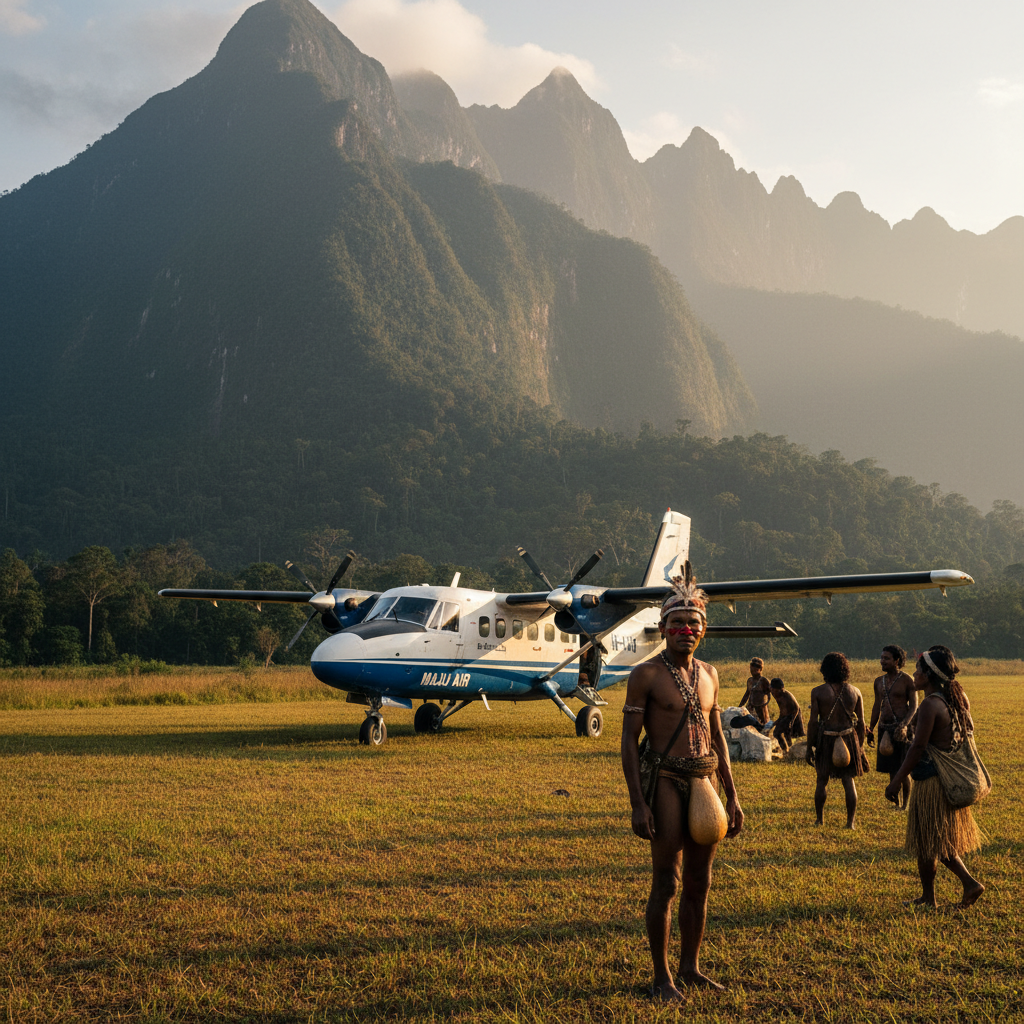
Baliem Valley has exactly one airport — Wamena Airport, IATA code WMX. There are no road or rail connections from the rest of Indonesia. Every traveler arrives by air, and every flight comes from Jayapura (DJJ), the provincial capital of Highland Papua.
The two carriers
Wings Air (Lion Air subsidiary) operates two daily flights JJP → WMX on ATR 72-600 turboprop aircraft. Schedule: 06:30 departure JJP, 07:30 arrival WMX. Second daily: 11:00 JJP, 12:00 WMX. Round-trip fare $180-$240 typically. Booking: lionair.co.id direct or via WIngs Air mobile app.
Trigana Air operates one daily flight JJP → WMX on ATR 42 aircraft. Schedule: 09:00 departure JJP, 10:00 arrival WMX. Round-trip fare $200-$280. Booking: typically through travel agents — Trigana’s online booking system is unreliable, we book on behalf of expedition guests.
Why flights cancel
Wamena Airport sits in a mountain valley at 1,650m elevation. The surrounding peaks reach 4,500m within 30km. Cloud cover and fog ground flights regularly — particularly during morning hours April-October when valley fog is heaviest until 10:00 AM, and afternoon convection during the wet season (November-March).
A reasonable expectation: 1 in 8 flights gets canceled or delayed. We build a buffer day into every expedition for exactly this reason — both arrival in Wamena and return to Jayapura.
Booking strategy
Book the morning Wings flight (06:30) for arrival in Wamena. If it cancels, you’re rebooked on the same-day 11:00 flight or next-morning’s flights. Booking the afternoon flight as your primary leaves you exposed to a 1-day delay scenario.
For return: book the morning flight again. If it cancels, you can typically still make a same-day Jakarta connection on the afternoon flights. An afternoon Wamena departure that cancels strands you overnight in Jayapura and possibly causes you to miss your international onwards.
Getting to Jayapura
Jayapura (DJJ) connects to: Jakarta (CGK) 6-8 daily on Garuda + Lion + Citilink, $180-$320 one-way; Makassar (UPG) 4 daily, $140-$220; Bali (DPS) 2 daily on Garuda, $200-$300. From Western origins, route via Jakarta or Singapore-Jakarta-Jayapura — total transit 24-32 hours from Europe, 18-26 from US West Coast.
Wamena Airport on arrival
WMX is a single-runway airport with a basic terminal — there are no shops, limited seating, and one luggage carousel. Indonesian government agents check incoming visitors against a Surat Jalan registration system; foreign visitors must have a permit pre-arranged (we handle this for all our expedition guests). Allow 30-45 minutes for arrival processing.
Once outside, you’ll find taxis (negotiate flat rate to central Wamena, typically IDR 75,000 / $4.65) and 4WD pickups available for hire. Mobile signal is functional in Wamena town but disappears within 5km outside town.
We handle Wamena logistics for you
Permits, flights, ground transport, and the buffer days. Tell us your dates and we’ll arrange everything.
The call of the Baliem Valley: A luxury redefined
Stepping onto the tarmac at Wamena, the crisp mountain air, alive with the scent of distant woodsmoke and damp earth, immediately transports you to a realm untouched by the familiar rhythms of modern life, a gateway to the legendary Baliem Valley. For the discerning luxury traveler, this remote highland region of West Papua, Indonesia, represents the ultimate frontier of authentic exploration. Here, luxury isn’t measured by thread counts or Michelin stars, but by the unparalleled privilege of deep cultural immersion, striking natural beauty, and the profound silence of a world largely unchanged for centuries. The valley, set at an elevation of approximately 1,600 meters (5,200 feet), offers a profound escape, a place where time slows and genuine connection replaces superficial indulgence.
The primary draw for many is the opportunity to engage with the Dani tribe, one of Papua’s most iconic indigenous groups. Their vibrant traditions, distinct architecture, and ancient way of life offer a rare glimpse into a culture that has largely maintained its heritage despite increasing external contact. Visiting the Baliem Valley is not merely a trip; it is an expedition into a living museum, where every interaction is a lesson in resilience and cultural pride. This is where luxury travel transcends comfort, evolving into an experience of profound personal enrichment and understanding, an exclusive journey into the heart of human history and tradition.
Far from the well-trodden paths of Bali or Lombok, the Baliem Valley presents a challenge and a reward for those seeking distinctive adventures. The region’s raw, untamed beauty, from its cascading rivers to its dramatic limestone cliffs, serves as a magnificent backdrop to the vibrant culture of the Dani people. This destination caters to a very specific kind of luxury traveler: one who values authenticity over ostentation, who seeks stories to tell rather than just sights to see, and who understands that true exclusivity often lies in the rarity of the experience itself. The journey to the Baliem Valley is, in essence, a quest for the extraordinary, a testament to the enduring allure of the world’s most remote and culturally rich corners.
Curating your exclusive Baliem Valley expedition
Navigating the complexities of travel to such a secluded region demands meticulous planning and the expertise of specialized luxury tour operators. Beyond securing your flight from Jayapura to Wamena, the true art of a Baliem Valley expedition lies in crafting a bespoke itinerary that prioritizes comfort, safety, and meaningful engagement. Private charters, though an added expense, can offer unparalleled flexibility and privacy, transforming the transit into an integral part of the luxury experience. Upon arrival, the absence of conventional five-star hotels necessitates a redefinition of luxury accommodation. Exclusive eco-lodges, meticulously maintained guesthouses, or even custom-designed glamping experiences provide comfortable havens amidst the rugged landscape, often boasting striking views and an intimate connection to nature.
A key component of any high-end trip to the Baliem Valley is the provision of expert, multilingual guides. These professionals are not merely navigators; they are cultural interpreters, facilitators of genuine interactions, and guardians of ethical tourism practices. They possess an intimate knowledge of the local customs, dialects, and the delicate balance required to visit the Dani tribe respectfully. Such guides ensure that every village visit, every trek, and every cultural demonstration is conducted with sensitivity and mutual respect, enhancing the visitor’s understanding while safeguarding the local culture. Luxury travel here is synonymous with responsible travel, ensuring that your presence contributes positively to the communities you visit.
Logistics extend to securing the necessary permits, arranging private transport within the valley (often involving sturdy 4×4 vehicles), and organizing porter teams for trekking expeditions. Reputable operators specialize in these intricate details, ensuring a seamless and stress-free journey. For instance, obtaining the required surat jalan (travel permit) for foreign visitors to Papua is a critical step, usually managed by your tour company. These curated experiences allow travelers to fully immerse themselves in the region’s unique offerings, from exploring traditional Dani villages like Kurulu, famous for its ancient mummy, to venturing deeper into the valley to witness the striking tiered agricultural terraces. For more insights into the region’s rich biodiversity and cultural heritage, authoritative sources like Wikipedia’s Baliem Valley page offer valuable context.
Immersive encounters with the Dani tribe
The heart of any luxury expedition to the Baliem Valley lies in its immersive cultural encounters with the Dani tribe. Far from being passive observers, travelers can participate in carefully arranged experiences that offer deep insights into their ancient way of life. Imagine witnessing a mock tribal war, a spectacle of elaborate headdresses, body paint, and traditional weaponry, performed not for entertainment but as a demonstration of historical customs and prowess. These events, often culminating in a traditional pig feast, cooked in an earth oven using hot stones and banana leaves, are powerful, sensory experiences that connect visitors directly to the Dani’s enduring heritage. The aroma of roasted pork, the rhythmic chants, and the vibrant attire create an memorable tableau.
Beyond these powerful demonstrations, bespoke itineraries can include visits to local markets, where the vibrant exchange of goods and stories unfolds daily, or treks to sacred sites and salt lakes, such as the Ilugwa salt spring, a traditional source of salt for the Dani people. These treks, often led by local guides from the Dani tribe themselves, offer not only remarkable natural vistas but also a deeper understanding of their symbiotic relationship with the land. The opportunity to learn about their agricultural practices, observe their intricate weaving techniques, or simply share a moment of quiet contemplation with village elders provides a profound and rare connection that epitomizes luxury travel in its most authentic form.
For those seeking even greater immersion, some luxury operators facilitate stays in traditional Dani huts, modified for comfort, allowing travelers to experience daily life from within the community. These experiences are carefully managed to ensure cultural sensitivity and respect for the local people. It’s a privilege to witness the intricate details of their daily existence, from the construction of their distinct round and oval huts to the communal rhythms of village life. Such close encounters with the Dani tribe offer an unparalleled perspective, forging memories that extend far beyond a typical vacation. For further details on the broader Indonesian cultural landscape, Indonesia.travel’s guide to Wamena provides an excellent starting point for exploring this fascinating region.